
Ring Insurance in New Zealand: Do You Need to Cover Your Men’s Wedding Band?

What Wedding Ring Insurance Covers
A lot of blokes assume the ring’s covered because “everything in the house is insured.” It’s not, or at least not properly. Standard contents insurance in New Zealand treats jewellery as a specified-items category with a cap, and that cap is usually nowhere near what a decent men’s wedding band costs once you add a diamond, a custom inlay, or a solid gold build. Ask your insurer what the single-item limit is on your policy. Chances are it’s a few hundred dollars unless you’ve listed the ring separately.
Wedding ring insurance, in practice, is either an endorsement added to your existing home and contents policy (specified item cover) or a standalone jewellery policy through a specialist insurer. Either way, it’s meant to cover three things: total loss (the ring’s gone, full stop), theft, and accidental damage (a titanium band that’s cracked after getting caught in machinery, for example, or a carbon fibre ring that’s chipped). Some policies also cover mysterious disappearance, which matters more than people think, because a lot of wedding ring claims aren’t dramatic break-ins, they’re “I took it off to wash the car and never found it again.”
The other thing worth knowing upfront: not every ring behaves the same way when something goes wrong. A gold band can usually be resized, re-plated, or repaired. A black ring in tungsten carbide can’t be resized at all, and if it cracks, it’s replaced, not fixed. That distinction should shape what kind of cover you buy, not just whether you buy it.
Choosing the Right Cover
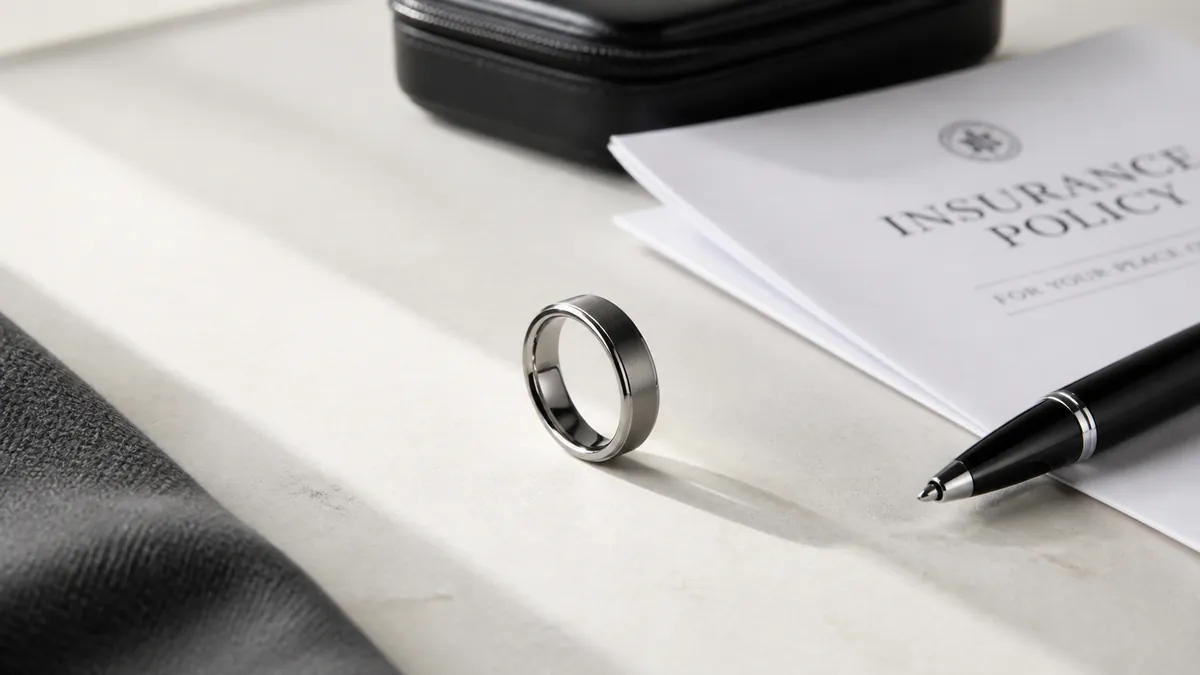
There are basically two paths. The first is adding your ring as a specified item on your existing contents policy. This is the easiest option and usually the cheapest if you already hold a policy with one of the big NZ insurers. You’ll need a valuation or a purchase receipt, and the premium typically runs at somewhere between 1% and 2% of the ring’s insured value per year. For a $1,200 ring, that’s roughly $12 to $24 a year, which is not a lot of money for peace of mind.
The second path is a standalone jewellery insurer, which some people prefer because the claims process is built around jewellery specifically rather than being a side note in a general contents policy. These policies sometimes offer worldwide cover, which matters if you’re the type who takes the ring off skiing or diving and it goes over the side of a boat somewhere that isn’t New Zealand.
Whichever route you take, check three things before signing: the excess amount, whether “new for old” replacement is included (so you get a like-for-like ring, not a depreciated cash payout), and whether the insurer requires you to replace through their nominated jeweller or lets you choose your own. That last point matters more than people realise, because a nominated-supplier clause can mean you don’t end up back with the ring style you actually wanted in the first place.
Ring Styles and What They Need
The material of the ring changes the insurance conversation more than most people expect. Tungsten carbide is scratch resistant and looks brilliant for years, but it’s brittle under a direct hard impact and can’t be resized. If yours cracks, a repair quote isn’t really on the table, so full replacement cover is the only cover that actually does anything for you.
Titanium is tougher in the sense that it bends before it breaks, and a lot of titanium bands can be adjusted slightly, though not to the same degree as gold. If you’ve gone custom, say a custom titanium ring with an inlay of wood, antler, or meteorite, get that inlay valued and described specifically on the policy, because generic titanium cover often assumes a plain band and won’t reflect what the inlay actually adds to replacement cost.
Carbon fibre rings are light and tough day to day, but the weave pattern is part of what you paid for, and a cheap “equivalent” replacement from an insurer’s default supplier won’t always match. If you’ve bought a carbon fibre ring, ask specifically whether the policy will replace with the same brand and pattern or just “a carbon fibre ring of similar value,” because those aren’t the same thing.
Ceramic is a slightly different case again. It’s genuinely scratch-proof under normal wear, but a hard knock against something like a doorframe or a dropped weight at the gym can chip or shatter it outright. If you’ve picked a ceramic ring, don’t assume “hard” means “unbreakable.” It means the opposite of gold: fine under scratches, vulnerable under sudden shock.
And then there’s silicone, which is its own category entirely. A silicone ring is usually worn precisely because it’s disposable and safe around machinery or weights, so most people don’t insure them at all and just keep a spare or two in the drawer. If that’s your everyday band while the “real” one sits in a safe for special occasions, your insurance conversation should really be about the ring in the safe, not the one you’re wearing to the gym.
What to Check Before You Buy
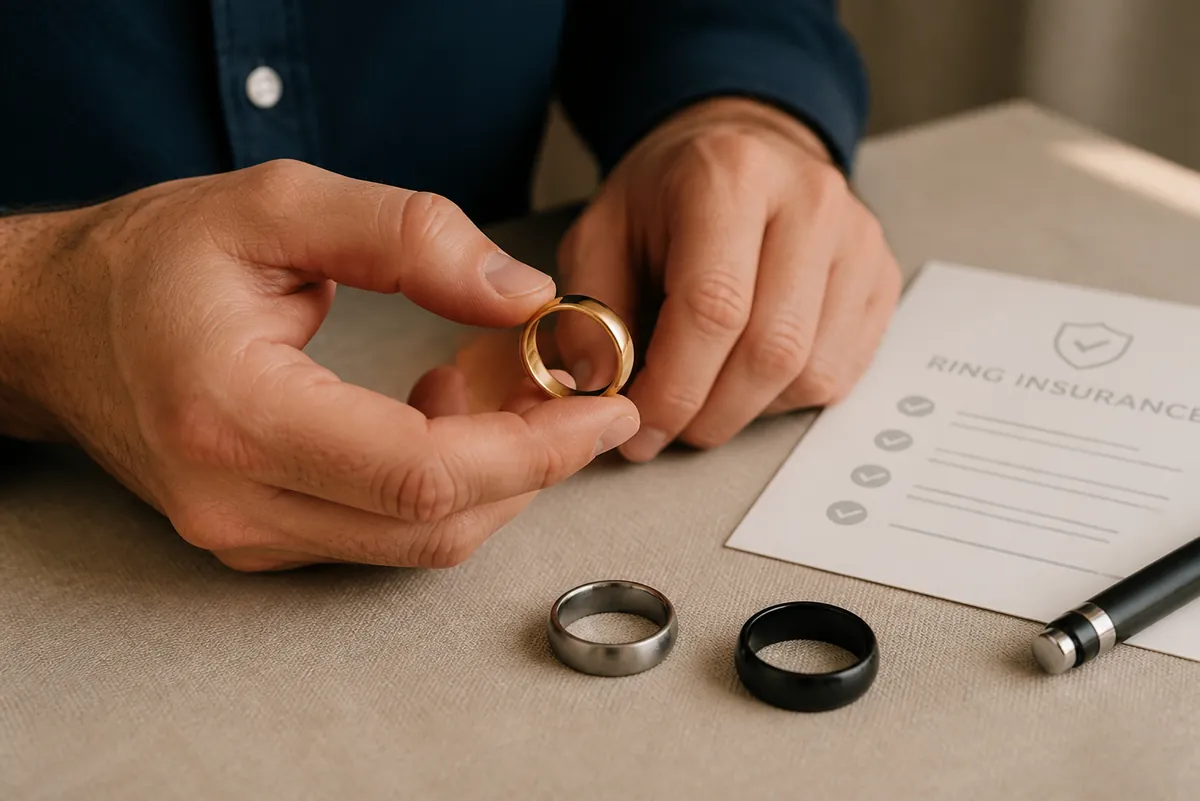
Get a proper valuation, not just the receipt. A receipt shows what you paid, a valuation shows what it’d cost to replace today, and those two numbers drift apart over time, particularly with gold and diamond pieces where metal and stone prices move independently of what you paid a few years back. If you went the custom-made route, get the valuation to describe the specific work, the setting, and any engraving, because a generic “gold band” valuation won’t reflect a hand-finished custom piece.
Photograph the ring properly, close up, with any engraving visible, and keep the file somewhere that isn’t just your phone (a cloud backup or emailed to yourself works fine). If you ever need to make a claim, a clear photo speeds up the process enormously and removes a lot of the back-and-forth an insurer might otherwise put you through.
Check the excess against the ring’s value. Some policies apply a flat excess of $100 to $250 regardless of claim size, which is fine on an $1,800 ring but starts to look silly on a $400 band, where the excess could eat a big chunk of any payout. If your ring sits at the lower end of the value scale, it might genuinely be cheaper long-term to self-insure (set aside the premium money and replace it outright if it’s ever lost) rather than pay for a policy that barely pays out anything after the excess.
Read the exclusions on wear and tear. No policy covers a ring simply looking tired after a decade of daily wear, that’s expected and normal, not a claimable event. What you’re covering is sudden loss, theft, and accidental damage, not the gradual dulling that any gold ring or diamond ring will show after years on a working hand.
Tips From the Trade
Take the ring off before manual work, always, and this isn’t really an insurance tip so much as the single biggest reason jewellers see damaged or missing bands in the first place. Ring avulsion injuries (where a ring catches on machinery or a fence and the finger takes the force) are a genuine and fairly common workplace injury, and no insurance policy fixes that part of the story. If your job involves your hands around machinery, gym equipment, or manual trades, a lot of guys keep a cheap silicone band for work and save the metal ring for outside of it. It solves the safety problem and the insurance problem in one move.
Resize before you insure, not after. If the ring’s a bit loose or tight, get that sorted first, because an insurer valuing a ring that then needs resizing anyway is money spent twice. It also matters for tungsten and ceramic rings specifically, since they can’t be resized at all, so the sizing needs to be right from day one or the ring needs replacing outright regardless of insurance.
Bundle it with your contents renewal rather than treating it as a separate purchase. Insurers often waive or reduce the additional premium for specified items when they’re added at renewal time rather than mid-term, and it’s one less policy to keep track of. If you’re shopping cufflinks or other jewellery for the wedding day itself, it’s worth asking your insurer whether those can go on the same specified-items list while you’re at it, since most policies handle a small jewellery list just as easily as a single ring.
Finally, re-value every few years, not just at purchase. Gold prices in particular have moved a lot over the past few years, and a ring insured at 2023 values could be meaningfully underinsured by 2026. It only takes a phone call to your insurer to update the figure, and it’s the cheapest five minutes you’ll spend protecting the ring.
Frequently Asked Questions
What is the best wedding ring insurance NZ?
There’s no single “best” policy, it depends on your ring’s value and whether you already hold contents insurance. Adding the ring as a specified item to your existing home and contents policy is usually the cheapest and simplest route for most Kiwi households. A standalone jewellery policy is worth comparing if you want worldwide cover or a claims process built specifically around jewellery.
How do I know which cover is right for me?
Start with the ring’s material and value. A brittle, non-resizable metal like tungsten or ceramic really only benefits from full replacement cover, since repair usually isn’t possible. If the ring’s value is low relative to a policy’s flat excess, self-insuring (setting the premium aside) can work out cheaper than a formal policy.
What should I check before buying a policy?
Confirm the excess, whether replacement is “new for old,” and whether you can choose your own jeweller rather than being locked into the insurer’s nominated supplier. Get a current valuation and clear photos ready before you apply, since these speed up any future claim considerably.
Are there budget-friendly insurance options?
Yes, specified-item cover added to an existing contents policy is generally the most affordable option, often around 1% to 2% of the ring’s value per year. For lower-value bands, some people choose to self-insure instead, since a flat excess can otherwise eat most of a small payout.