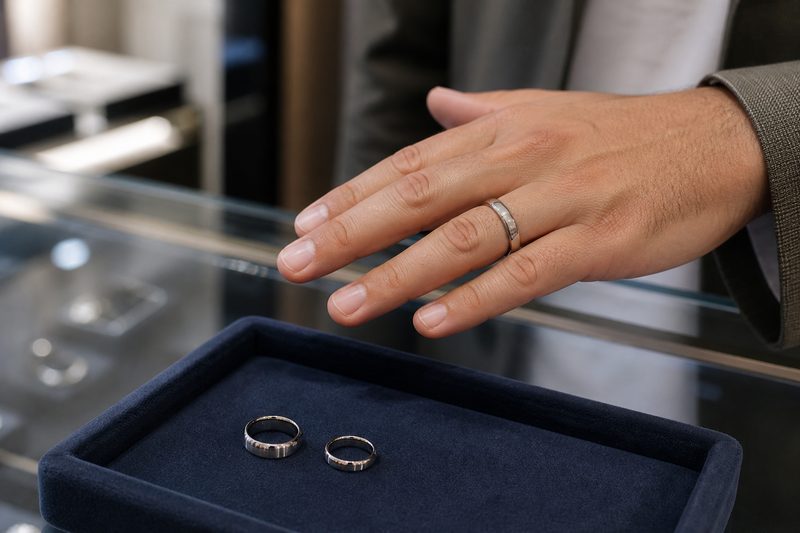

Men’s Pinky Ring Size Guide for NZ: How to Measure and Fit

Pinky rings have moved from niche accessory to a regular part of how Kiwi men dress, whether for work, weddings or weekends. The catch is that the little finger sits differently to the others — shorter, often with a more pronounced knuckle — so the sizing you use for a wedding band rarely transfers across. This guide walks through how pinky ring sizing actually works in New Zealand, what affects the fit, and how to measure accurately at home before you order.
Everything below uses the NZ alphabetical sizing system (A-Z), which matches the UK and Australian systems exactly. If you’ve been sized at a jeweller in Auckland, Wellington or Christchurch, that letter size carries straight across to any reputable NZ retailer, including online.
How Pinky Ring Sizing Works in New Zealand
New Zealand uses the same letter-based sizing as the UK and Australia: a continuous alphabet from A through to Z, with half sizes (A½, B½ and so on) for finer adjustments. A typical men’s wedding ring finger sits somewhere between Q and Z, while pinky fingers usually run several sizes smaller — most Kiwi men land between J and Q on the little finger.
If you’re shopping internationally, the US uses a numerical system (roughly 1-16) and continental Europe uses circumference in millimetres. Most NZ retailers list at least the UK/NZ letter and the US number side by side, so conversion is rarely a hassle. For a full chart you can reference at home, the NZ men’s ring size guide covers every size with the millimetre equivalents.
Why the Pinky Is Different
Pinky fingers tend to taper more sharply between the knuckle and the base than ring or middle fingers. That means a ring sized only at the base may slide over the knuckle too easily, while a ring sized at the knuckle can spin loosely once it’s on. Good pinky fit accounts for both points — snug enough at the base that the ring doesn’t rotate constantly, loose enough at the knuckle that you can get it on and off without struggle.
Factors That Affect Pinky Ring Size
Even within the same hand, your pinky size isn’t a single fixed number. A few things shift it:
Band Width
Narrow bands (2-4mm) fit closer to your measured size. Wider bands (6mm and up) cover more skin and feel tighter for the same internal diameter, so most jewellers recommend going up half a size — or occasionally a full size — when the band is 8mm or wider. This matters more on the pinky because there’s less finger length for a wide band to sit on comfortably.
Temperature and Time of Day
Fingers swell in heat and shrink in cold. A Christchurch winter morning will give you a noticeably smaller pinky than an Auckland summer afternoon. Measuring at the end of the day, at normal indoor room temperature, gives you the most representative size — that’s roughly the average state your finger will be in while you’re actually wearing the ring.
Salt, Exercise and Diet
High-sodium meals, alcohol, long-haul flights and intense exercise all cause temporary swelling. If you’ve just come back from a run or had a salty takeaway, wait an hour or two before measuring.
Dominant vs Non-Dominant Hand
The pinky on your dominant hand is often a quarter to half a size larger than the non-dominant one. Decide which hand the ring is going on before you measure.
How to Measure Your Pinky Ring Size at Home
You don’t need a jeweller’s mandrel to get a workable measurement. Three methods cover most cases.
The String or Paper Strip Method
Cut a thin strip of paper about 6mm wide and 100mm long, or use a piece of non-stretchy string. Wrap it around the base of your pinky, mark where it overlaps with a pen, then lay it flat against a ruler and read the length in millimetres. Match that circumference to an NZ ring size chart. If your knuckle is significantly wider than the base, repeat the measurement over the knuckle and pick a size that lands between the two readings.
Measuring an Existing Ring
If you already own a ring that fits your pinky well, measure the inside diameter (edge to edge across the centre) in millimetres. Diameter is more reliable than wrapping a ruler around the outside of the band, because band thickness varies.
Printable Ring Sizer
Most NZ jewellers publish a printable ring sizer you can cut out and wrap around your finger. Print at 100% scale — not “fit to page” — and check the calibration ruler before trusting the result.
Professional Sizing
For a high-value piece in gold or platinum, getting sized in person at a local jeweller is worth the short trip. Most NZ jewellers will size your finger for free, even if you’re buying online afterwards.
Choosing the Right Pinky Ring
Once you have a confident size, the next decisions are style, material and how the ring will sit alongside anything else you wear.
Style
Signet rings are the traditional pinky style — flat or domed top, often engraved with initials, a family crest or a simple monogram. Plain bands work well on the pinky too, especially in slimmer widths. Statement rings with gemstones or carved detail draw more attention; they suit men who already wear other jewellery and want the pieces to read as deliberate.
If you wear a wedding band, the pinky ring usually sits on the opposite hand to avoid visual clash, though plenty of men wear both on the same hand without issue.
Material
Material choice changes the look, the price, the long-term maintenance and whether the ring can be resized later. The main options on the NZ market:
- Tungsten — extremely hard, virtually scratch-proof, heavier than steel, cannot be resized. Good for men who work with their hands and don’t want to think about wear. Browse tungsten options.
- Titanium — light, hypoallergenic, very durable, limited resizing. Suits anyone who finds heavier metals uncomfortable on the pinky. See the titanium rings.
- Gold (9ct, 14ct, 18ct) — classic signet ring material, fully resizable, develops a softer patina over time. Higher karats are softer and scratch more easily. Available in yellow, white and rose. Check the gold collection.
- Platinum — denser and more durable than gold, naturally white, fully resizable, sits at the top of the price range.
- Silicone — soft, safe around machinery and electrics, cheap enough to keep a spare. More common as a wedding band than a pinky ring, but useful as a backup.
Fit and Comfort
A well-fitted pinky ring rotates slightly but doesn’t spin freely, slides over the knuckle with mild resistance, and doesn’t leave a deep mark when you take it off after a few hours. If it pinches, swells the skin above it, or won’t come off in warm weather, it’s too small. If it falls off when you flick your hand downward, it’s too large.
Adjusting and Resizing
Even with careful measurement, a ring sometimes arrives needing a tweak. Your options depend on the material.
Resizable Materials
Gold, platinum, silver and most palladium rings can be resized up or down by a jeweller, usually within two sizes either way without altering the design. Resizing typically takes a week or two and costs anywhere from $60 to $200 NZD depending on the metal and the size change. Rings with stones set around the full band are harder to resize and may cost more.
Non-Resizable Materials
Tungsten, ceramic and most titanium rings cannot be resized because the metal can’t be stretched or cut and rejoined cleanly. For these, the answer is either to exchange the ring for the correct size or, for very small adjustments, use a ring adjuster — a small silicone or plastic sleeve that fits inside the band and takes up the extra space. Adjusters work well for half-size discrepancies but look obvious if you’re trying to make a ring two sizes smaller.
Buying Pinky Rings in New Zealand
Buying online has become the default for men’s jewellery in NZ, partly because the in-store selection at most high-street jewellers leans towards women’s pieces and engagement rings. A few NZ-specific things to check before you order:
- GST — Reputable NZ retailers display prices including GST. Be wary of overseas sellers quoting in NZD without explaining whether GST and import duties have been handled.
- Delivery — Free shipping across NZ is standard for jewellery orders above modest minimums. Rural delivery adds a day or two, occasionally a small surcharge.
- Returns and resizing — Check the return window and whether the retailer offers a free first resize. For pinky rings in particular, where sizing is harder to judge, a generous exchange policy matters more than it does for a standard wedding band.
- NZ climate — Coastal humidity in places like Tauranga and the Bay of Islands accelerates tarnishing on silver and lower-karat gold. Tungsten, titanium and platinum handle the conditions without complaint.
If you’re still narrowing down style, the full men’s rings catalogue and the dedicated pinky ring section are the easiest starting points.
Final Notes on Getting the Size Right
Pinky ring sizing rewards a bit of patience. Measure twice, on a normal day, at a normal temperature, on the hand the ring is actually going on. If you’re between sizes, the right call depends on the band width: go up for wider bands, stick with the smaller size for slim bands. And if you’re buying a non-resizable material like tungsten, lean on a retailer’s exchange policy rather than guessing — the cost of swapping a size is far less than the cost of owning a ring you can’t comfortably wear.
Common questions
What is the average men's pinky ring size in NZ?
Most Kiwi men fall between size J and Q on the pinky, with the middle of that range being around size M or N. Your exact size depends on hand size, band width and which hand you wear the ring on. Measuring at home or getting sized at a local jeweller is far more reliable than guessing from averages.
Does NZ use the same ring sizing as the UK and Australia?
Yes. New Zealand, the UK and Australia all use the alphabetical A-Z sizing system, including half sizes. A size R in Auckland is the same as a size R in London or Sydney, so you can use UK or AU charts interchangeably. The US numerical system is different and needs conversion.
Can a tungsten or titanium pinky ring be resized?
Tungsten cannot be resized at all because the metal is too hard to cut and rejoin without cracking. Titanium can sometimes be resized down a fraction, but most jewellers won't attempt more than that. For these materials, an exchange for the correct size is the standard fix, which is why a clear NZ return policy matters.
How long does delivery take for rings within New Zealand?
Standard NZ urban delivery is usually 2-4 working days for in-stock rings, with rural delivery adding one to two days. Free shipping across New Zealand is common for online jewellery orders. Custom-made or resized rings take longer — typically one to three weeks depending on the workshop.
Should I size my pinky ring in summer or winter?
Aim for a measurement that reflects your finger's average state, which usually means late afternoon at normal indoor temperature. Fingers swell in NZ summer humidity and shrink in cold Christchurch or Queenstown winters, so a midday autumn or spring measurement tends to be the most representative across the year.